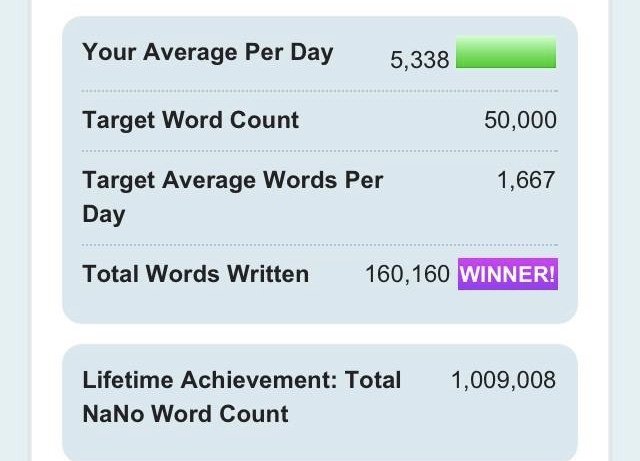
Now that NaNoWriMo is literally just around the corner (no, I am not freaking out—you’re freaking out), it’s time to talk about last-minute prep. Various people have asked me to share my secrets for productivity in November, and I have shared a little before, but I figured I would cover it a bit more. If this doesn’t help you, well then, at least I’ve gathered my thoughts for myself.
Before you jump into these tips, please keep in mind that they are more geared toward those willing to throw caution and good sense to the wind in the interest of going beyond the 50K. And because this advice comes from my personal experience, what works for me may not work for you. (Translation: If your hands fall off mid-month, please don’t sue me.)
Dedication. Whatever your goal is, reaching it has to be the thing you want more than anything else. It has to be the thing that you choose over movies and books and other distractions nine times out of ten. You have to decide ahead of time what your level of commitment is going to be, and then you need to stick to that. It’s okay to decide that you need to bow out, but try not to decide that on day three. The first week can be especially daunting, and your mind is going to be thinking of all the reasons to quit. My recommendation is to quit only if you begin experiencing health issues (both mental or physical) and are worried that pushing yourself any harder will cause you long-term damage. Most importantly, learn to enjoy the struggle and the strain, because overachieving will not be a cakewalk.
Rewards. If you’re reward-oriented, make sure that you set up a reward system ahead of time and, if at all possible, put someone else in charge of that system so you can have a level of accountability. In all honesty, I haven’t had huge success using any reward systems in the past, because I’m not a hugely reward-oriented person. Or rather, my reward is the writing itself. But I also know that if I let myself place a massive book order for every 100,000 words I write, well dang, I’d be at 3,000,000 before you could say, “I think Liz’s laptop just burst into flames.”
Writing Music. If you listen to music while writing, it might be a good idea to compile your playlists ahead of time. I know that, at least from my experience, it’s far too easy to spend tons of valuable writing time looking for the perfect writing song. Don’t do that. It’s secret procrastination, and you will end up hating yourself.
Writing Cues. In a similar vein, it’s really important to have some writing cues in place before November begins—things that will let your brain know it’s time to focus on writing. If you’re an intake learner like me, it helps to have a specific drink (in my case, coffee) or a snack that you only grab when you’re ready to write. The flavors and smells will help your brain get into writing mode. If you’re an auditory person (also like me), it helps to have specific music or white noise that you only listen to while writing. And if you have a specific location where you are consistently more productive (coffee shops and church for me), try to make sure you end up there as often as possible.
But make sure—MAKE SURE—that you only use these cues when you are intending to sit down and focus on writing. As tempting as it might be, you can’t let yourself cave and use your writing cues while procrastinating or doing chores or whatever. They will lose their golden touch if you do. But if you keep them sacred, they are likely to help even when you’re in a writing slump. Simple behavioral conditioning, folks.
Procrastination Game Plan. Yes, I did just say that. You are going to need to take breaks, especially if you are planning to go whole hog this November. But if you don’t plan your break activities ahead of time, your quick three-minute jaunt on Twitter could turn into a three-hour full-emersion social studies experience. And valuable learning aside, you are going to hate yourself. Make sure you have some protocols in place so that doesn’t happen, because you need to make sure your breaks don’t leave your discouraged. Your breaks are there to sharpen you and prepare you for another bout of writing, so approach them accordingly.
For those of you who write on a computer, like me, consider taking a break from anything screen-related when you take your writing breaks. Eye strain is a real problem when you’re logging the hours to get all the words written. Don’t make this harder for yourself by scrolling through your Twitter feed between word sprints. Movies and TV shows are fine, because you’re not stressing your eye muscles quite so much, but try to keep your face a couple feet away from the screen. Also, be sure to get plenty of fresh air and exercise so your brain doesn’t turn into a bag of stale potato chips. If your phone takes dictation, maybe go on a walk and talk out some of your story.
Have a system in place. Set timers for yourself and respect them when they go off, even if you have to drag yourself kicking and screaming back to your writing seat.
If you’re having trouble thinking of non-social-media-related breaks, here is a handy dandy list of suggestions:
Read. Mosey on over to the kitchen and make coffee. And because moderation is not a thing we embrace during NaNoWriMo, just give in and drink straight from the coffee pot. You know you want to. Pick flowers. Pet an animal. Talk to the animal. When I had rats, I would discuss major plot points with them and verbally untangle my story issues. (But maybe choose a kinder animal, like a puppy or a lizard. Rats can be harsh critics. They require perfection and thus are better to consult during the editing stages.) Clean up the disemboweled mouse the cat left on the patio….again. Climb a tree. Fall out of said tree. Enjoy your first ambulance ride and hospital stay. Make sure to take notes and incorporate this into your story. Go out to eat, or better yet, try a challenging, new recipe at home. Braid your cat’s hair. Treat the thousands of scratches on your arms. Clean things. Play with mud. Get into the spirit of autumn. Eat a leaf and put pumpkins on your hands. Terrorize the neighbors. Enjoy learning firsthand about police procedure and holding cells. Have fun.
Most Importantly—Log the Hours. I know this seems obvious, but it’s the one that gets short-changed the most. When you’re writing large chunks of words, it’s so easy to get overexcited and take more breaks than you should. It’s also too easy to assume that you will always be writing at peak speed. Don’t. Set yourself a schedule, and when the schedule says write, you write. (You can find my schedule for last year in this post.) Those who wrote 3,000,000 last year logged about 19-23 hours a day. In other words, you have to put in the time. The words will not magically appear on your document overnight.
I don’t know—I feel like I give the wrong impression that this is easy, and I know that I type quickly, but like I said, this is not a cakewalk. I repeat, this is not a cakewalk. So please don’t come into this expecting a cakewalk, because if you do, you will end up quitting. (And by all means, if you hit a wall and you need someone to light a fire under your butt, shoot me a message, and I will yell at you—nicely—until you start writing again. You can find my contact form on the sidebar.)
I don’t know—I feel like I give the wrong impression that this is easy, and I know that I type quickly, but like I said, this is not a cakewalk. I repeat, this is not a cakewalk. So please don’t come into this expecting a cakewalk, because if you do, you will end up quitting. (And by all means, if you hit a wall and you need someone to light a fire under your butt, shoot me a message, and I will yell at you—nicely—until you start writing again. You can find my contact form on the sidebar.)
Some Final Words. Now that you’ve read all my extremely serious advice, please keep a couple caveats in mind. If you aim to overachieve as much as I do, and if you’re like me, you will experience guilt about making Wrimos who are writing less feel bad. You will want to share you successes with people, because you are excited, but keep in mind that people won’t always be nice about it. You will sometimes inadvertently discourage people or make them jealous.
With regards to my word count, please keep in mind that I have a high pain tolerance and a relatively low regard for my own health when it comes to competition. I will write until I can’t physically move my fingers well enough to type. I will be using wrist braces this year, but I haven’t in the past, and I am paying for that now. Don’t always do as I do unless you are willing to accept the health consequences that come with.
With regards to my word count, please keep in mind that I have a high pain tolerance and a relatively low regard for my own health when it comes to competition. I will write until I can’t physically move my fingers well enough to type. I will be using wrist braces this year, but I haven’t in the past, and I am paying for that now. Don’t always do as I do unless you are willing to accept the health consequences that come with.
In Summary. If you’re planning to overachieve this year, ready yourself for the worst and hope for the best. (And take all my advice with a grain of salt.) Remember that this is a marathon. If you lose sight of the finish line, the race will become grueling and unbearable. You will spend most of the time feeling like you’re about to vomit up your lungs. But if you don’t quit halfway through, you will thank yourself come December. So run.
What?
Well, that’s it for today, my little coffee beans. What are some pieces of writing/NaNoWriMo advice that you’ve benefited from? Are you planning to participate in NaNoWriMo this month? What are your favorite ways to procrastinate? Do you also struggle with avoiding the fascinating productivity-black-hole that is Twitter?